This past Sunday I had lunch with Pjeter and his 72-year-old mother. We went to a restaurant in a sports park (hard to explain, but it was a nice restaurant). In celebration of Greek Orthodox Easter, Pjeter's mom gave everyone at the table an egg dyed a beautiful crimson red. After she had distributed the eggs, she placed a hardback book on the table. Among the pages of the book were lodged about a dozen old photographs. Here is the story told by the book and the pictures:
During WWII, an American military transport plane carrying Army nurses took off from Catania, Sicily on a mission to fetch wounded soldiers from forward positions farther north. A storm and German Messerschmitts blew the plane off course, and it crashed in rural Albania, near Pjeter's ancestral home. All 30 Americans survived the crash landing and eventually made their way on foot to Pjeter's grandfather's village. Pjeter's grandfather was asked, because he spoke some English, to help the survivors. He did, trekking with them for several weeks through the mountains in winter so they could be rescued off the eastern coast of Albania. Soon thereafter, he was kidnapped by the Albanian security forces. For years his family did not know what happened to him, until finally one of the police officers who had been among the group that executed him revealed the location of his body. One of the pictures carried by Pjeter's mom was a black-and-white photograph of human bones in a shallow grave - her father's.
Other photos showed Pjeter's grandmother with the author of the book, one of the rescued Army nurses who had returned to Albanian in the mid-1990s to thank those who had helped them. Pjeter's mom was only a little girl when all this happened, but she obviously cherishes the exploits of the grandfather she hardly knew.
Thursday, April 19, 2012


Thursday, April 12, 2012
Roots
During March Albanian workers enjoyed another holiday-inspired long weekend (!). By happy circumstance, my sister-in-law and her boys were traveling in Sicily that very same weekend. So close to Albania! I couldn't resist a rendezvous with them. Our plan was to do some hikes along the eastern shore, to eat as much gelato and cannoli as possible, and to tour some of the historic sites. But I had a personal agenda as well. You see, my grandfather was born in Messina province in Sicily, and I'd always been curious about that side of the family. For whatever reason, the Old Country wasn't something we spoke about, even though my father cherished his Italian heritage. A few years ago I did some ancestry research, but I never had been able to establish which town my grandfather came from, why he left, and why he never went back.
So here was the perfect opportunity to do some on-the-ground research. My wonderful sister-in-law and nephews were game for a little genealogical adventure. So it was that on a Saturday in mid-March we drove up into the little hill town of Roccavaldina (pop. 1100).I didn't have much of a plan, but we'd been advised that we should just ask someone, because people in the small towns know all the families and all the history.
Parking in the main square, we saw that there was only one cafe in town. Luckily, it was open and there were about 20 men hanging out in front, talking and playing cards. We marched right up and in broken Italian said I thought my grandfather had been born there and I was looking for any remaining relations.
As promised, everyone was excited to help and started talking all at once. But when I told them that my grandfather emigrated in 1910, the crowd grew quiet, and one gentleman looked at me and said "You know, that was a long time ago." I felt like such a fool - what a lame scheme! Who would remember such ancient history?
Well it turns out the Roccans did. Ten minutes later I was sitting on a couch in my cousin Salvatore's house, being introduced to my 85-year old second cousin, Nicolina. She was so happy to see me, a perfect stranger claiming to be related, that she gave me a big hug and started crying.
We passed an hour or so sharing photos and information about the family tree. In the end, I didn't learn the story behind my grandfather's decision to emigrate at the age of 19 and never to return (Sicilians keep some things close to the chest), but I was amazed by the sense of community and family I saw there.

 |
| View from Roccavaldina |
 |
| Consultation |
Parking in the main square, we saw that there was only one cafe in town. Luckily, it was open and there were about 20 men hanging out in front, talking and playing cards. We marched right up and in broken Italian said I thought my grandfather had been born there and I was looking for any remaining relations.
As promised, everyone was excited to help and started talking all at once. But when I told them that my grandfather emigrated in 1910, the crowd grew quiet, and one gentleman looked at me and said "You know, that was a long time ago." I felt like such a fool - what a lame scheme! Who would remember such ancient history?
 |
| Old building |
 |
| Roccavaldina Crest |
 |
| Church |
We passed an hour or so sharing photos and information about the family tree. In the end, I didn't learn the story behind my grandfather's decision to emigrate at the age of 19 and never to return (Sicilians keep some things close to the chest), but I was amazed by the sense of community and family I saw there.

Thursday, March 22, 2012
Dita e Verës (Summer Day)
 |
| Plum tree in bloom |
I was a little surprised on my run that morning to see crowds of people walking in and towards the city park. Normally at that time of day (6:30 am) the city streets are quiet and empty, and only a handful walkers or joggers are seen in the park. But on this day, dozens of vendors already were laying out their wares on the main avenue in the park. Others were firing up grills to cook savory snacks for sale. I saw several park visitors happily yanking flower-laden branches off the park's mimosa trees (which about a week ago had burst into fragrant yellow blooms).

Happily, the city closed off the main street to vehicular traffic on Wednesday. By mid-morning pedestrians had flooded the avenue, walking back and forth and enjoying the fine weather.
There were so many walkers that even motorbikes could not squeeze in. (Motorbikes are not exactly considered vehicular traffic here. They frequently drive on the sidewalks and in the park, so they're more like a hybrid between a pedestrian and a vehicle).

Wednesday, March 14, 2012
Albanian Alpinists
This past weekend our friend Niko of High Albania organized a group to climb Mali i Gramozit, the fourth-highest peak in Albania (it's about 2500 meters, but the elevation gain is only about 1400 meters because the starting point is in the
foothills). Nevertheless, Gramozit is considered a fairly important peak to bag, so Niku invited other members of the Balkan mountaineering community to hike with us. Thus it came to pass that about 20 alpinists from all over Albania rolled into the small town of Erseke on Saturday night. Among those in attendance were representatives from the Berati club, and even a member of the club in Pristina, Kosovo.
It was an interesting group - even more interesting than usual. On the one hand we had people from Tirana who were brand-new to hiking. On the other hand we had guys who'd been fooling around in the mountains for years. As a person who herself has spent a fair amount of time fooling around in the mountains in Alaska, I was interested to compare notes with these guys (and the first thing I noticed is that they were all guys).
I learned that mountaineering clubs in Albania, while small, are quite dedicated. They even have members that they refer to as "coaches" or "trainers" who advise the less experienced ones. I noticed that many of the alpinists had technical clothing and mountaineering equipment such as ice axes and crampons. These are things that few Albanians own, even Albanian hikers.
One thing they didn't have was a map. A few had checked out the route on Google Earth. Although it's possible to get reasonably accurate GPS-downloadable maps of Albania, the guys in these clubs pretty much eschew that technology. As my new friend Blerim explained to me "We go by experience."
But I think the most interesting contrast for me was not about gear but or maps but about climbing style. All of the alpinists on this outing practiced what I would refer to as "expedition style" mountaineering, where you carry a very big, very heavy pack and trudge slowly and methodically to the summit.
I associate this style of mountaineering with multi-day treks to very high and remote peaks such as those found in the Himalayas. In the Alps and elsewhere in Europe, fast and light is the mantra. If you're fit enough, you can be up and down in a day or two, so why go heavy? Myself, I stand firmly in the fast and light camp, if for no other reason than because the joy drains out of me when I'm carrying a 50 pound pack. But more on that later.
The actual hiking was the usual Balkan muddle. The hotel owner overslept so we had to start our hike at 5:30 am without breakfast or coffee. Up on the mountain it was cold and really windy. Some of the footing was tricky due to wind slab and freeze-thaw. Then, it turned out that no one had actually ever climbed this peak before - or at least not within recent memory - so routefinding was an issue (no maps).
It was whiteout near the top. Most of the non-climbers turned back, although several hardy civilians from the High Albania group soldiered on to the summit.
Back at the hotel after everyone was safely down, my fast-and-light style (and my gender) was a topic of discussion among the alpinists. I don't think they quite knew what to make of me, so I told them I'm from Alaska. That seemed to do the trick.
 |
| Gramozit from Erseke (J. Carver photo) |
It was an interesting group - even more interesting than usual. On the one hand we had people from Tirana who were brand-new to hiking. On the other hand we had guys who'd been fooling around in the mountains for years. As a person who herself has spent a fair amount of time fooling around in the mountains in Alaska, I was interested to compare notes with these guys (and the first thing I noticed is that they were all guys).
I learned that mountaineering clubs in Albania, while small, are quite dedicated. They even have members that they refer to as "coaches" or "trainers" who advise the less experienced ones. I noticed that many of the alpinists had technical clothing and mountaineering equipment such as ice axes and crampons. These are things that few Albanians own, even Albanian hikers.
One thing they didn't have was a map. A few had checked out the route on Google Earth. Although it's possible to get reasonably accurate GPS-downloadable maps of Albania, the guys in these clubs pretty much eschew that technology. As my new friend Blerim explained to me "We go by experience."
 |
| Ready for anything (J. Carver photo) |
I associate this style of mountaineering with multi-day treks to very high and remote peaks such as those found in the Himalayas. In the Alps and elsewhere in Europe, fast and light is the mantra. If you're fit enough, you can be up and down in a day or two, so why go heavy? Myself, I stand firmly in the fast and light camp, if for no other reason than because the joy drains out of me when I'm carrying a 50 pound pack. But more on that later.
 |
| Whiteout |
The actual hiking was the usual Balkan muddle. The hotel owner overslept so we had to start our hike at 5:30 am without breakfast or coffee. Up on the mountain it was cold and really windy. Some of the footing was tricky due to wind slab and freeze-thaw. Then, it turned out that no one had actually ever climbed this peak before - or at least not within recent memory - so routefinding was an issue (no maps).
 |
| (J. Carver photo) |
 |
| Berati Mountain Club + 1 (J. Carver photo) |
Back at the hotel after everyone was safely down, my fast-and-light style (and my gender) was a topic of discussion among the alpinists. I don't think they quite knew what to make of me, so I told them I'm from Alaska. That seemed to do the trick.
Tuesday, March 13, 2012
Relationships
I've struck up a relationship with a butcher near my apartment. He speaks to me in rapid-fire Albanian while I smile and gawp at the display case containing big trays of unlabeled meat cuts and whole lambs. Unlike other retail clerks in Tirana, he does not know a single word of English. Plus, I think he speaks with some kind of accent, because even words I know sound different when he says them. About 90% of the time I have no idea what he's talking about. Truly it is a miracle that we are able to complete any type of retail transaction at all. I feel like an idiot every time I go there.
Why, then, would I continue to patronize this shop? Well, at this point I feel like we've both invested so much energy in our efforts to communicate that we would be losing all that if I switched butchers now. Plus, he is always so cheerful, and he doesn't display any hint of impatience with my incomprehension and slowness. And in a funny way, his refusal to slow down or speak more clearly is like a testament to his belief that I am indeed capable of communicating in Albanian. It's like a vote of confidence in my language skills. How can I walk away from that?
So the other day I upped the ante. My one and only kitchen knife had gotten so dull that I had to do something. I slipped it into my backpack and took it to his shop. He was happy to sharpen it for me on the spot, for free. After an awkward exchange about where the knife came from (at least I think that's what he was asking me), I smiled and thanked him. We didn't need words to appreciate the beauty of a perfectly sharpened kitchen knife.
Why, then, would I continue to patronize this shop? Well, at this point I feel like we've both invested so much energy in our efforts to communicate that we would be losing all that if I switched butchers now. Plus, he is always so cheerful, and he doesn't display any hint of impatience with my incomprehension and slowness. And in a funny way, his refusal to slow down or speak more clearly is like a testament to his belief that I am indeed capable of communicating in Albanian. It's like a vote of confidence in my language skills. How can I walk away from that?
So the other day I upped the ante. My one and only kitchen knife had gotten so dull that I had to do something. I slipped it into my backpack and took it to his shop. He was happy to sharpen it for me on the spot, for free. After an awkward exchange about where the knife came from (at least I think that's what he was asking me), I smiled and thanked him. We didn't need words to appreciate the beauty of a perfectly sharpened kitchen knife.
Sunday, February 19, 2012
Carnival in Shkodra
This weekend was the opening of the annual carnival festival in Shkodra. Shkodra is a pleasant town a couple of hours from Tirana. Originally settled by the Illyrians in the 7th century B.C., the town's history includes conquest by Romans, Turks, Huns, Visigoths, Ostrogoths, Slavs, and Italians (particularly the powerful city-state of Venice in the late 1300s). The variety of cultural and religious influences brought by all these invaders resulted in an impressive religious and ethnic tolerance and booming trade.
In my short stay I noticed two particularly nice things about the town. First is an avenue that is closed off to vehicular traffic (a nice reprieve from the car-mania of Tirane). Also I noted that a lot of residents ride bikes instead of driving.
The second particularly nice thing is the siting of a mosque and two Christian churches close enough together that decorative lights can be strung among the three buildings for festivals and special occasions. I can't think of another place that exhibits such religious inclusivity.
The genesis for the carnival celebration (as I understand it) came from the historical connection between Shkodra and Venice, Italy. As mentioned above, Venice actually ruled this area during its heyday, and many of the older buildings show Italian architectural influence. But that connection was a long time ago and it was just one among many. The other important influence revitalizing the festival has been the support of a local businessman who founded a factory that manufactures hand-made, Venetian-style masks for export to Italy and points beyond. The masks are absolutely beautiful.
The opening ceremony, which occurred on Saturday afternoon under sunny skies, included speeches by local and visiting politicians, a live band playing covers of North American songs that were popular a few years ago, and some fireworks. The vibe was upbeat and wholesome, kind of like a high school pep rally, but with masks.

The highlights were the groups of young people from all the local schools attired in costumes and masks.
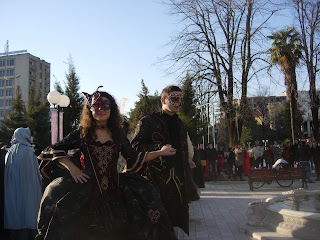
The older youths' costumes were quite elaborate. They all seemed so proud to have been chosen to play an important role that they were not bothered by the cold.
Warming up with a glass of raki in a nearby bar after the opening ceremony, I wondered about the origins of the festival. Apparently, the vibe at the original Venetian carnival was a good bit darker and more morally ambiguous than it is now. In earlier centuries, the citizens of class-conscious Venice wore masks to conceal their identities, enabling commoners and nobles to mix, and facilitating anonymity among those inclined to illicit or criminal pursuits (of which many were available). As class structures and social mores gradually loosened, the importance of carnival declined. It actually died out for a number of years, not being revived until the late 1970 in Venice and more recently here in Shkoder. In both places, today's carnival is more of a tourist attraction than a vehicle for acting out illicit fantasies. So I wonder what those 13th century Venetians would think of us now?
 |
| Costumed revelers with mosque in the background |
In my short stay I noticed two particularly nice things about the town. First is an avenue that is closed off to vehicular traffic (a nice reprieve from the car-mania of Tirane). Also I noted that a lot of residents ride bikes instead of driving.
The second particularly nice thing is the siting of a mosque and two Christian churches close enough together that decorative lights can be strung among the three buildings for festivals and special occasions. I can't think of another place that exhibits such religious inclusivity.
The genesis for the carnival celebration (as I understand it) came from the historical connection between Shkodra and Venice, Italy. As mentioned above, Venice actually ruled this area during its heyday, and many of the older buildings show Italian architectural influence. But that connection was a long time ago and it was just one among many. The other important influence revitalizing the festival has been the support of a local businessman who founded a factory that manufactures hand-made, Venetian-style masks for export to Italy and points beyond. The masks are absolutely beautiful.
 |
| Masks from the local factory |
The opening ceremony, which occurred on Saturday afternoon under sunny skies, included speeches by local and visiting politicians, a live band playing covers of North American songs that were popular a few years ago, and some fireworks. The vibe was upbeat and wholesome, kind of like a high school pep rally, but with masks.

The highlights were the groups of young people from all the local schools attired in costumes and masks.

The older youths' costumes were quite elaborate. They all seemed so proud to have been chosen to play an important role that they were not bothered by the cold.
 |
| An excellent turnout |
Warming up with a glass of raki in a nearby bar after the opening ceremony, I wondered about the origins of the festival. Apparently, the vibe at the original Venetian carnival was a good bit darker and more morally ambiguous than it is now. In earlier centuries, the citizens of class-conscious Venice wore masks to conceal their identities, enabling commoners and nobles to mix, and facilitating anonymity among those inclined to illicit or criminal pursuits (of which many were available). As class structures and social mores gradually loosened, the importance of carnival declined. It actually died out for a number of years, not being revived until the late 1970 in Venice and more recently here in Shkoder. In both places, today's carnival is more of a tourist attraction than a vehicle for acting out illicit fantasies. So I wonder what those 13th century Venetians would think of us now?
Tuesday, February 7, 2012
Convenience
In most parts of central Tirana, you can't walk more than a block or two without passing a produce stand. It might be a young man with two boxes of whatever fruit or vegetable is abundant that week set up on the sidewalk. Or it might be a woman with twenty or more different items from the area. A few vendors specialize in only one food, for example olives. One fellow sells only bananas.
Many times the person you buy your vegetables from also will have some farm-fresh eggs or dried figs for sale as well. Butcher shops proliferate just two blocks away from my apartment. Each of them carries fresh, non-factory-farmed chickens, pigs, beef and lamb.
Three blocks away are a couple of fresh fish shops, which is not so special except that once you've picked out your fish they will cook it for you on the spot. Ten minutes later they hand you a nice little "to go" container. Calamari, anyone?
With this kind of abundance and convenience, I find myself falling into a glib mindset. I no longer bother to plan any meals or shopping trips. Why plan when I can just grab whatever looks freshest on the walk to or from work? The flavors of the produce and meat are so good that elaborate preparations are overkill. Just roast the vegetables and the chicken with some salt and pepper - nothing else required. Or toss lettuce, cucumber and fresh tomatoes with some dark green local olive oil and vinegar - done.
 These lazy ways are in contrast to my habits in car-centric and produce-challenged Anchorage. There, the twice-a-month trip to Costco or the farmer's market is planned and timed just so. In the summer, we might decide to do a hike on Turnagain Arm so we can combine it with a trip to the South Anchorage Farmer's Market. We discuss whose turn is it to drive over to Costco and schlep all those boxes. We stock up. We buy what is unripe and wait for it to ripen (or rot).
 It took me a month to realize that's the wrong approach here. Never buy unripe, because the guy on the next block has ripe. Don't stock up on a bunch of produce that might spoil because it's so easy to grab fresh.
I am now so lazy that a couple of times I've actually started cooking dinner knowing that I'm missing an ingredient, intending to fetch the forgotten item from my next-door vegetable stand while the rest of my dinner is actually cooking on the stove. I am down and back in less than 5 minutes. (Yes, I know that's bad.)
Oh I will miss this convenience when I'm gone!
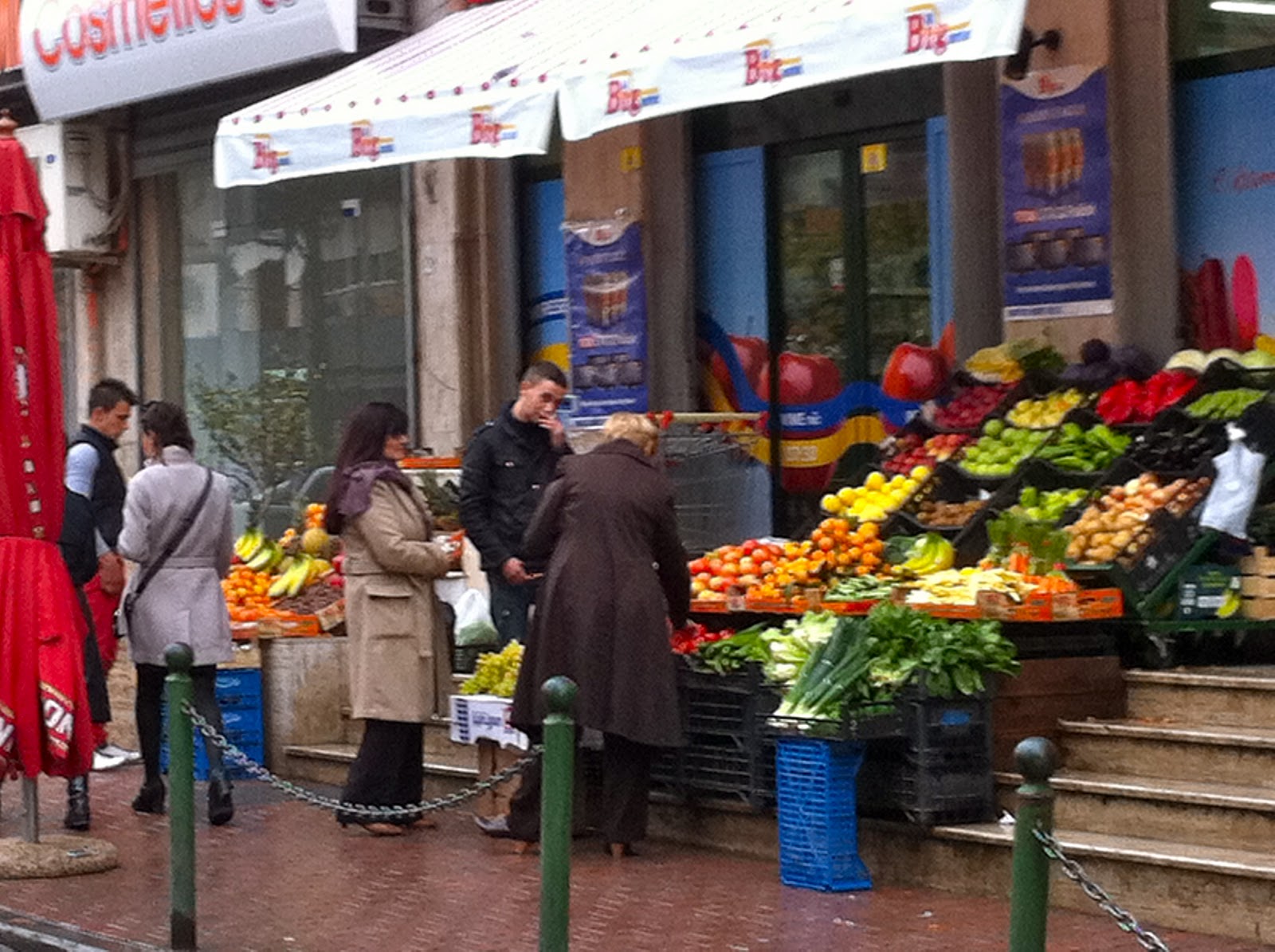 |
| Produce stand next to my apartment |
 |
| Produce entrepreneur |
With this kind of abundance and convenience, I find myself falling into a glib mindset. I no longer bother to plan any meals or shopping trips. Why plan when I can just grab whatever looks freshest on the walk to or from work? The flavors of the produce and meat are so good that elaborate preparations are overkill. Just roast the vegetables and the chicken with some salt and pepper - nothing else required. Or toss lettuce, cucumber and fresh tomatoes with some dark green local olive oil and vinegar - done.
 These lazy ways are in contrast to my habits in car-centric and produce-challenged Anchorage. There, the twice-a-month trip to Costco or the farmer's market is planned and timed just so. In the summer, we might decide to do a hike on Turnagain Arm so we can combine it with a trip to the South Anchorage Farmer's Market. We discuss whose turn is it to drive over to Costco and schlep all those boxes. We stock up. We buy what is unripe and wait for it to ripen (or rot).
 It took me a month to realize that's the wrong approach here. Never buy unripe, because the guy on the next block has ripe. Don't stock up on a bunch of produce that might spoil because it's so easy to grab fresh.
 I am now so lazy that a couple of times I've actually started cooking dinner knowing that I'm missing an ingredient, intending to fetch the forgotten item from my next-door vegetable stand while the rest of my dinner is actually cooking on the stove. I am down and back in less than 5 minutes. (Yes, I know that's bad.)
Oh I will miss this convenience when I'm gone!
Tuesday, January 24, 2012
Mali Bukaniku

This past weekend I went with the High Albania group to climb Mount Bukaniku (around 1800 meters). The peak looked to be a relatively straightforward ascent, especially since we were starting from 900 m. Well, it probably is straightforward in the summer, but as it turns out there's a lot of snow there in January. In the end, it took us six hours, with around two of those hours spent post holing up a steep slope through breakable crust on top of sugar snow, sinking in up to mid-thigh (or above) with every step.

Now this is interesting because (as my loving spouse will tell you), I normally eschew post holing. In fact, my standard reaction to the least little bit of post holing is immediately to start sniveling about being wet and cold, followed by didactic discourses along the lines of "since I'm so much shorter the snow is proportionally deeper for me making it much harder for me than everyone else" etc etc etc.
 |
| Enjoying the novelty of deep snow |
But I didn't snivel this time. Instead, I broke trail. Partly I did it for the warmth generated by the extra exertion (since I didn't really bring much in the way of winter hiking gear); but mostly I felt honor-bound, as the one with the most winter training and experience, to lead. I noticed that only a few of the Albanians had technical clothing (one young man actually came the whole way in what appeared to be leather street shoes and dress socks). I don't think many of them had experienced these types of snow conditions before. And I know the steepness and the post holing wore them out long before we reached the summit.
Yet, wet, cold and tired, they laughed and joked all the way to the top. There was no complaining, and certainly no sniveling. They never thought of turning back. In short, they embraced the experience.
The group's enthusiasm certainly transformed my reaction. It's so important and yet I am prone to forget - attitude is everything. I shouldn't need to travel halfway around the world to remember that simple truth; yet sometimes stripping away the familiar and routine is exactly what we need to remind us about what's important in life.
 |
| The summit at last! |
Monday, January 16, 2012
Tirana Hash
 |
| Hashy terrain |
One can find a hash in just about every good-sized city in the world. So of course one of the first things I did upon arriving here was to find the Tirana Hash. It took me two tries to locate the unmarked cafe that serves as the meeting place on Saturday mornings, but when I finally did I was warmly welcomed. That's the beauty of Hash - you go to a foreign city, walk up to a group of complete strangers and are immediately treated as a member of their club.
All hashes share a few characteristics: socializing, some amount of walking or running through the countryside, singing of irreverent (and often risque) songs, and drinking beer in a circle to conclude the outing.
 |
| Drinking beer in the circle |
What else? Well, the idea is the group goes together to a (hopefully) previously planned starting place. Then, everyone walks or runs a route that is marked by the leader (the "hare") in some way for all to follow (we mark ours with white flour).
 |
| The group spreads out on a recent hash |
But all hashes are slightly different. Both hashes with which I'm familiar (here and in Ulanbaatar) are more on the "relaxed" side of things. We sing the songs, drink the beer, encourage the silliness, and do the socializing; however the planning of the weekly outings is kept to a bare minimum. So we don't really pursue the hare; actually no one really even runs at all. And there are no false trails or tricks (although on a recent outing three of us did have to go back and fetch an ambassador who was having trouble negotiating a slippery downhill).
 |
| Encouraging of silliness |
Also, we don't really have enough people to scout out good routes or mark trails in advance. We've been relying lately on the Vicar and Tokyo Joe (assigning of nicknames is another hashy tradition), and they've been turning in strong performances. On the days when no one's had time to plan, we just make up a destination right on the spot.
Even without a lot of organization, it's a great way to meet interesting people and see the countryside.
 |
| Kruje hash |
The songs I could do without, as only a 12-year-old boy could find them amusing. But on the other hand, listening to those songs is what makes chugging beer at noon seem like a good idea (the more buzzed I am, the less offensive they seem). So it all comes together in a kind of hashy gestalt, and a good time is had by all.

Tuesday, January 10, 2012
Mali Gamtit
 |
| Mali Dajti near Tirana |
 |
| They were a little spooked when I came by |
I'm still trying as often as possible to get out on the weekends and enjoy the Albanian countryside. Escaping the sprawl of the city is not as easy as I had hoped it might be, even though Tirana sits a mere 10-15 kilometers away from any number of lovely peaks. But as I mentioned in an earlier post, hiking as we in Alaska think of it is virtually unknown here.
For example, on a recent outing our group passed a couple of farmers working in their field. As soon as he saw us, one of them jumped up, came over and started giving us directions to the nearest road. When we explained that we weren't looking for the road, he was genuinely puzzled. One of the Albanians in our group gamely tried to explain ("We just enjoy walking around in nature") but he clearly thought we were nuts.
On another outing in which I was solo, I came upon a shepherdess tending her flock. My limited vocabulary made conversation difficult; but one thing she said was clear even to me: "Why on earth did you come here on foot - don't you have a car?". I had no better answer than my friend had given that poor farmer.
That's why it is especially fun to meet Albanians who like to hike in the mountains. I went with just such a group this past weekend to climb Mali Gamtit.
 |
| Reservoir |
About 20 of us gathered at 9 am to drive 30 minutes or so to the base of the peak, located near the reservoir that supplies drinking water for Tirana.
 |
| Resting on the way up |
It was an interesting group. Some clearly had done this kind of thing before, while others seemed to have little idea of what was involved - namely about 900 meters of elevation gain.
No matter. One thing I have learned about Albanians is that they are highly social and very good at managing groups. We eventually separated ourselves into a variety of sub-groups. Some went to the top, others stopped halfway, and still others barely made it past the first steep uphill. This seemed perfectly natural to everyone, and it seemed to work just fine.
 |
| Looking down on the reservoir |
It was a lovely day, so the ones who stopped short of the top found sunny spots in which to wait for the others.
The views were fine - we could see the ocean and the port city of Durres in the distance.
Here are a few photos of the views on the way up and from the summit.


 |
| Full moon rising |
 |
| Tired but happy at the end of the day |
Saturday, December 31, 2011
Gjeldeti
Albanian Turkey—A Model for American Thanksgiving
(A guest post by Thomas, visiting from Alaska)
Between Christmas and New Years, Susanne and I took an overnight trip to Berat, Albania’s oldest community. Berat is an inhabited citadel with terraced slopes, and narrow, cobblestone streets bordered by fifteen-foot-high walls. To walk these ancient streets, white-washed and maze-like, is transforming. Two thousand four-hundred years of history boggles this Alaskan’s mind, whose hometown has yet to celebrate its one-hundredth birthday. At the top of a 700 foot climb lies the main entrance to the fortified portion of Berat, which once protected a thriving urban center and 42 churches within its walls, but now lies in partial ruin from repeated attacks, including a German bombing during WWII. But this blog is not about Berat, or Balkan history. Susanne can blog on that later. This post is about turkey. Specifically, the turkey we ate in a tiny family run café within Berat’s massive stone walls.
Turkey, it turns out, is a New Year’s tradition in Albania. Although we may have missed our own traditional turkey feast at Christmas, we indulged ten-fold and a few days late in Berat.
Albanian turkey is oven roasted and served on a generous bed of dressing made from homemade bread, turkey drippings and giblets. Side dishes such as mixed salad, roasted vegetables, and traditional byrek, a cheese filled pastry, fight for space on the table. At times it’s hard to find a spot to wedge a glass of wine between all the platters. The volume of food is so generous, the flavors so robust, that the absence of central heating inside the ancient stone house goes nearly unnoticed. (The owner did remove the five gallon jug of home-pressed olive oil from atop a kerosene heater and moved the heater next to our table.)
 |
| Doomed.... |
Despite a wide variety of tasty foods, the turkey tantalized most. It was rich and moist and tasted like turkey, not like a frozen, leathery Butter Ball raised in a warehouse, slaughtered months earlier, and injected with saline to enhance weight and juiciness. How fresh is Albanian, free-range turkey? Well, as rich forkfuls of dark meat melted on our palates, the owner walked through the café to rinse his bloody knife.
We’d heard turkey gobbles in the background, as common as braying donkeys in Greece or angry car horns in Tirana. Upon seeing the knife, however, we recalled hearing one foreshortened gobble, which normally occur in threes.
This time of year, turkey transactions occur on nearly every street corner. Albanians carry their live purchases home, upside down by the legs, the same way American shoppers sling Fred Meyer bags of groceries to their cars.

 |
| Toting home dinner |
 |
| Cash & Carry |
So why can’t Americans, who love turkey and make it the centerpiece of major holidays, figure out how to put real turkey on their tables? That’s for another blog.

Christmas in Albania
Although I missed family and friends at home, spending the Christmas season away from the US was interesting. I wondered how, or whether, a predominately Muslim country would acknowledge the day. The answer, in hindsight, was obvious.
Albanian Christians (mostly Greek Orthodox), mark the day as most Christian families do, with a special family meal. Those who are observant might also acknowledge the religious aspects of the holiday at church, many attending midnight mass.
The non-Christians pretty much ignore the religious part of the holiday and embrace the secular aspects. The shops and streets of Tirana are decked out in Santa Claus displays, scenes of winter wonderlands, and blinking colored lights. In the main square, next to the statute of Albania's national hero Skanderberg, sits a giant fake evergreen tree decorated with lights.
 In short, Christmas unfolded pretty much the way I would expect in a country known for its religious tolerance - everyone did as their beliefs dictated and no one begrudged the others. This live-and-let-live attitude concerning religious practice and belief is, I feel, one of the greatest things about the Albanian worldview.

After so many years of state-sponsored religious persecution, the Albanian people truly understand the importance of separating church and state. People are happy to practice their own religion privately and happy to let others do the same.
Over Christmas weekend, Thomas and I visited the town of Korca. Korca sits at some elevation, so is colder than Tirana. The week before we arrived, it had snowed. It was nice to see the white snow, although I did get cold. Only two months here and already I'm losing my cold tolerance!
At one time, Korca was known as the Paris of Albania. We were charmed by its old stone buildings, including several churches. We also stopped by the brewery where they produce a couple of decent styles of of beer. We had a couple of exceptional meals, including lunch at La Montagne restaurant located outside of town at the top of a hairpin road in the direction of Mborja. In short, a lovely weekend and a white Christmas after all.
Gazuar!

 |
| Cathedral in Korca on Christmas Eve |
Albanian Christians (mostly Greek Orthodox), mark the day as most Christian families do, with a special family meal. Those who are observant might also acknowledge the religious aspects of the holiday at church, many attending midnight mass.
 |
| St. Nick takes a break from his toils |
The non-Christians pretty much ignore the religious part of the holiday and embrace the secular aspects. The shops and streets of Tirana are decked out in Santa Claus displays, scenes of winter wonderlands, and blinking colored lights. In the main square, next to the statute of Albania's national hero Skanderberg, sits a giant fake evergreen tree decorated with lights.


After so many years of state-sponsored religious persecution, the Albanian people truly understand the importance of separating church and state. People are happy to practice their own religion privately and happy to let others do the same.
Over Christmas weekend, Thomas and I visited the town of Korca. Korca sits at some elevation, so is colder than Tirana. The week before we arrived, it had snowed. It was nice to see the white snow, although I did get cold. Only two months here and already I'm losing my cold tolerance!
 |
| 14th century church |
 |
| Typical Korca streetscape |
 |
| Note bunkers in background |
 |
| La Montagne restaurant |
Gazuar!
 |
| Small chapel at La Montagne |
 |
| Fish from nearby Lake Ohrid |

 |
| Birra Korca delivery truck |
Subscribe to:
Posts (Atom)